

The short answer is this: loose powder stays inside its compact because three components are engineered as one system — a sifter or mesh insert whose opening size and open area are matched to the powder's particle size and flow behavior, a sealing stack (inner lid or rotating shutoff, closure liner or gasket, and a first-use seal) that closes every path powder could take when the pack is shaken or inverted, and dimensional tolerances tight enough that the insert seats against the jar wall with no gap for powder to migrate through. If any one of the three is wrong, the pack will pass a bench test on the filling line and still powder-coat the inside of a consumer's handbag in month two. Buyers should therefore evaluate the sifter, the closure and the tolerances together, with the actual powder formula, before approving an order.
This guide is written for beauty brands, private-label buyers, promotional products importers and packaging procurement teams sourcing empty loose powder compacts, powder jars and sifter cases. It explains what a loose powder compact actually consists of and which part does which job, how sifter opening size, mesh density and powder particle size interact, what a complete sealing system looks like and where leaks actually start, the dimensional tolerances that decide whether the assembly seals on the line and in the handbag, the failure modes that generate "powder everywhere" complaints, how to verify packaging quality with a fill-and-shake protocol that costs nothing, and how MOQ, decoration and packaging choices affect the final result. Only general industry knowledge is presented; no specific brand or manufacturer is recommended.

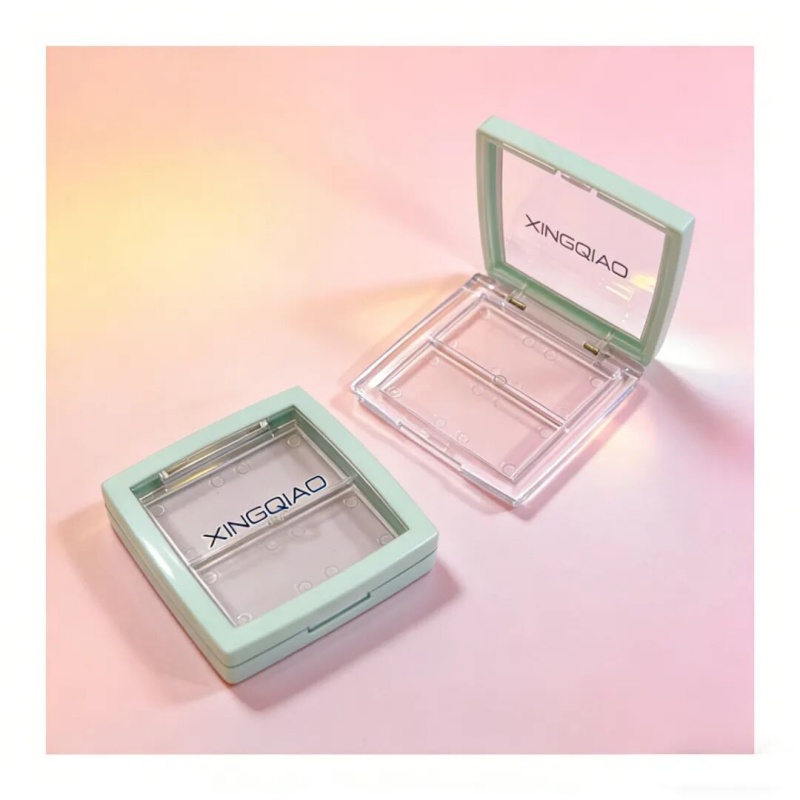
A loose powder compact is a SMALL multi-part machine for moving exactly the right amount of powder from storage to brush while admitting nothing in and letting nothing out. Its anatomy has five layers. The outer jar or case is the structural shell, injection molded in PP, ABS or petG, and carries the decoration and the closure threads or snap geometry. The powder reservoir holds the fill — often only half to two-thirds full, because headspace is not wasted space but working room that lets powder settle after shaking. The sifter or mesh insert sits above the reservoir and controls how powder reaches the application zone: a perforated disc presents discrete holes, while an elastic mesh or rigid screen presents a fine surface that a brush or puff can be pressed against. The sealing stack — an inner rotating cover or shutoff disc, a closure gasket or liner, and frequently a temporary first-use seal sticker or film — closes the powder path completely for transport and between uses. The closure, hinged or screw-on, with or without a mirror and puff compartment, completes the assembly.
Each layer has one failure that disqualifies it. A shell with a warped rim cannot seal regardless of the gasket. A reservoir with too little headspace packs powder against the sifter so that the first opening of the pack erupts. A sifter whose openings are mismatched to the powder either dumps product (openings too large for a fine, free-flowing powder) or clogs (openings too fine for a slightly moist or cohesive one). A sealing stack with a single point of failure — a liner omitted, a rotating cover that does not fully close, a snap lid with insufficient closing force — leaks. And a closure with a weak latch or shallow screw engagement pops open inside a bag. The engineering mindset that works is "leak paths, not parts": for each candidate path from reservoir to outside world, some component must block it.
The sifter is the most product-sensitive component in the pack, which is why it is also the one that most often defeats buyers who approve samples filled with the wrong powder. Three variables dominate.
Powder particles in cosmetic loose powders commonly sit in the range of a few microns to a few tens of microns, but agglomerates — clumps of particles that behave as larger units — govern flow. A perforated sifter with openings aRound one to two millimetres dispenses readily from almost any loose powder; openings much below half a millimetre begin to exclude agglomerates and dispense by attrition, which reads to the user as "the jar won't give up its powder." The practical rule: opening size should be chosen against the coarsest agglomerate the formula produces, not against the average particle size on the certificate of analysis.
For mesh-type sifters, common elastic mesh densities for cosmetic dispensing sit roughly in the 80-to-120-mesh region: coarser than that and too much powder passes at once, producing the classic "cloud" complaint; finer and pickup requires pressure that many users will not apply. Equally important is the total open area — a mesh that covers the full diameter dispenses faster than a small perforated disc, so the same powder can behave beautifully in one geometry and violently in another. When comparing supplier samples, change one variable at a time: same powder, same fill weight, same application motion.
A perforated disc dispenses by tapping into the lid or puff — simple, cleanable, and the right choice for free-flowing powders. An elastic or woven mesh dispenses by pressing — the right choice for finely milled setting powders loaded with a brush, and forgiving in the hand because the user controls pickup by pressure. A rotary lock sifter — a disc that slides or twists to align or block the holes — adds a closing mechanism in the sifter itself, and for travel-oriented products it is often the single most effective anti-spill upgrade, because it closes the powder path at the point where powder is loosest. Its trade-offs are cost, a second tolerance stack (the disc must neither bind nor rattle), and cleaning difficulty once powder works into the shutoff tracks.
Leak investigations on loose powder packaging almost always find the same short list of escape routes, and each maps to a specific countermeasure.
For screw closures, sealing engagement depth is the parameter that decides everything: a thread engagement of at least roughly three full turns with a compliant liner or gasket under the cap reliably blocks the rim path, while one-and-a-half turns on the same jar does not — the difference shows up only after the pack has been carried sideways for a week. For snap or hinged lids typical of compacts, the equivalent parameters are latch engagement depth, closing force and the fatigue behavior of the snap beam: a latch that closes with a crisp, definite click on day one and a mushy, half-seated feel after fifty cycles is a leak waiting for a handbag. Hinged compacts add a molded-in hinge whose living-hinge or pin design must retain closing force across the product's life.
Between sifter and closure, a rotating inner cover, a sliding shutoff or a simple inner lid provides the second barrier, and a temporary first-use seal — a pressure-sensitive sticker across the sifter or an induction-type film on the rim — provides the third for retail transport. These layers exist because redundancy, not perfection, is the achievable standard: any single gasket can be bypassed by one grain of powder caught on the sealing face, but two independent barriers almost never fail on the same journey. The subtle buyer mistake is testing only the first-open experience. After the temporary seal is removed, the pack relies entirely on the inner cover and closure — so the post-first-open configuration needs its own shake test.
The most underestimated path of all runs between the sifter insert's outer edge and the jar's inner wall. If the insert is under-sized, or the jar's inner diameter varies at the upper end of its tolerance, a visible-or-not gap admits powder during every shake, and the powder then sits above the sifter, contaminating the closure zone. The countermeasure is dimensional, not material: the insert needs a designed interference or gasket contact at the wall, verified across the actual tolerance range of the molded jar — which is why insert and jar should be qualified as a pair from one supplier, not sourced separately and married at the filling line.

Loose powder is unforgiving of slop because its particles are small enough to exploit any gap. The table below lists the dimensional and performance checkpoints that separate a clean pack from a complaining customer, with practical verification methods for each.
| Parameter | Typical target / range | Why it matters | How to verify |
|---|---|---|---|
| Sifter opening size | ≈ 0.5–2 mm perforations, matched to formula agglomerates | Controls dose and prevents clog or dump | Dispense test with actual powder |
| Mesh density (mesh type) | ≈ 80–120 mesh; open area sized to diameter | Brush pickup control, no clouding | Press-pickup test with brush |
| Sifter-to-wall fit | Designed interference or gasket contact; no free gap | Blocks migration above the insert | Backlight gap check on assembled jar |
| Screw thread engagement | ≥ ~3 full turns with liner seated | Rim leak path under carry conditions | Count turns; seal check after shaking |
| Snap / hinge closing force | Definite click; no loosening after 50 open-close cycles | Lid-opening failures in the bag | Cycle test by hand; feel comparison |
| Gasket / liner compression | Continuous contact, no visible gaps on closure face | Primary closure seal | Rim imprint test on paper |
| Fill headspace | Fill to ~2/3–3/4 capacity; space for settling | Prevents sifter flooding on first open | Fill-weight check vs capacity |
| Inverted carry leakage | No powder outside pack after agreed carry/shake protocol | The actual consumer complaint | Fill-and-shake test, see below |
| Mirror fit and protection | Seated flush, protected when closed, no rattle | Perceived quality; glass safety | Shake test rattle check |
| Puff compartment clearance | Lid closes fully with puff installed | Users store the puff in the pack | Assemble with intended puff |
| Decoration compatibility | Coating/print does not affect sealing faces or latch fit | Decorated parts seal worse than blanks | Test decorated samples, not blanks |
The last row deserves emphasis: decoration is a mechanical event, not just an appearance event. Spray coating adds microns to every face including sealing faces; plating builds on edges; hot stamping can stiffen a living hinge. A pack qualified with undecorated parts and shipped with decorated ones was never actually qualified.
Powder found everywhere on first opening almost always traces to transport, not to the user: sustained vibration settles fine powder upward through the sifter, and over-filled packs with insufficient headspace push powder against and past the insert. The countermeasures are fill discipline, adequate headspace, a first-use seal, and — for fine, low-density powders — a sifter geometry with reduced open area. Users can be helped by a short instruction: tap before opening, open away from the face.
Powder residue appearing over days of carry points to the closure interface or the inner cover: a liner that is not compliant enough to conform to the rim, thread engagement that is adequate vertically but not under the cross-loading of a bag, a rotating shutoff that vibrates open. Diagnosis is straightforward because the powder location tells the story — residue under the outer cap implicates the closure; residue on the sifter's upper side implicates the insert fit; residue around the hinge implicates the latch.
A pack that dispenses well when new and stingily after weeks is usually moisture-related: humidity or sebum introduced by a used puff makes agglomerates grow until they no longer pass the openings. Finer sifters suffer first. Formulation-side fixes (flow agents, anti-caking) belong to the powder brand; packaging-side fixes are larger openings, a mesh that tolerates pressure pickup, and instructing users to keep the puff dry and stored separately where the format allows.
A hinged compact lives or dies by its closing force at month six. Living hinges in PP survive thousands of cycles when the hinge is thick enough, unhurried in tooling and not decorated across the flex zone; pin hinges in ABS hold up when the pin is a real bearing, not a molded boss. The failure signature — a lid that stands slightly ajar — should be treated as a sealing defect, because it is one: an ajar lid is an open leak path.
A sample request that produces meaningful results states: the exact model and variant, the powder's bulk behavior (a retained sample of the actual formula is far better than a specification), the intended fill weight as a percentage of capacity, the applicator (brush or puff) and the application motion, the sifter type requested, whether a first-use seal and inner cover are required, and the decoration to be applied. Samples decorated and assembled exactly as production arrive with far more predictive power than undecorated shells.
Fill three sample packs to the intended production fill with the actual powder. Assemble fully — inner cover, closure, puff if the design includes one — and remove nothing. Test one pack as-is (first-open experience: tap, open, judge clouding and dispensing), then re-seal. Test the second pack inverted on a dark surface for twenty-four hours, then shaken through a standard motion — for example, one minute of simulated carry — and inspected for powder outside the pack. Test the third pack through fifty open-close cycles of the closure and hinge, then repeat the shake inspection. Finally open all three and grade the sifter's upper side: powder above a perforated insert means the insert fit or headspace is wrong; a clean upper side means the leak paths are closed. Record every judgment numerically — grams of residue, turns of thread engagement, clicks to closure — so that samples from two suppliers can be compared without adjectives.
A pack that dispenses cleanly, sheds nothing in inverted carry, survives fifty cycles and keeps its sifter's upper side clean is a qualified pack — for that powder, that fill and that applicator. Any failure localizes the defect: dispensing failures implicate the sifter choice; carry failures implicate the sealing stack; cycle-dependent failures implicate the latch or hinge; powder above the insert implicates fit or headspace. One round of this protocol, run before tooling or order confirmation, prevents the majority of loose-powder packaging disputes.
Stock compacts with existing molds carry the lowest MOQs and the shortest paths to samples; custom geometry adds tooling cost and normally a meaningfully higher minimum. For most brands the effective strategy is to select an existing compact family whose sifter, seal and closure architecture is proven, then differentiate through decoration and finish — coating, metallization, hot stamping, translucent or pearlescent materials — while insisting that decoration be included in the qualification samples. Components should be quoted as a system: insert, liner, seal and closure together, with the supplier responsible for the assembled leak performance rather than for individual parts that merely meet their own drawings. Packaging for retail should protect the closure from accidental opening in transit — a simple film wrap or band across the lid line — because a compact that arrives open has consumed its first-use seal before the shelf.

For products that will live in handbags, a rotary lock sifter combined with a compliant closure liner is generally the strongest combination, because the powder path is closed at the sifter itself and again at the rim. Perforated-disc packs can travel safely too, provided headspace, fill level and the first-use seal are all correct — but they rely on the closure as the only active barrier once opened, so liner quality and thread engagement carry more weight.
Because the closure is only one of three leak paths. Powder migrating above the sifter through a wall gap, an inner cover that does not fully close, or headspace so small that vibration drives powder against the closure will all produce leaks under a perfectly closed lid. Locate the residue: on the sifter's upper side points to insert fit or fill level; under the cap points to the liner or threads; on the mirror points to the inner cover.
Below capacity — commonly around two-thirds to three-quarters — leaving headspace for the powder to settle after vibration. Overfilling is the single most common cause of first-open eruptions, and it costs nothing to fix; the "generous fill" that impresses on a spec sheet is the same overfill that powders a customer's bag.
Neither is universally better; they dispense differently. Perforated discs tap out doses and suit free-flowing powders and puff application. Elastic or woven mesh dispenses under brush pressure and suits finely milled setting powders. Choose against the formula and the application routine, and compare samples using the identical powder — a sifter validated for one powder can misbehave with another.
Fill three assembled packs with the real powder: one for the first-open experience, one inverted and shaken for a carry-leak check, one through fifty open-close cycles followed by the same shake check. Then open all three and inspect for powder above the sifter. Count thread engagement turns, check the closure click after cycling, and confirm the lid closes with the puff installed. These checks, all doable on a desk, catch most leak mechanisms before production.
It can. Coatings add thickness to sealing faces, plating builds on edges, and decoration across a living hinge changes its fatigue life. Always qualify decorated, fully assembled samples rather than undecorated shells, and confirm that no coating has been applied to gasket seats or latch interfaces unless it was part of the tested design.

Loose powder packaging succeeds or fails as a system, and the system has exactly three load-bearing members: a sifter matched to the formula's real agglomerate behavior, a sealing stack with independent barriers at the sifter, the inner cover and the closure, and tolerances tight enough that those barriers actually touch where the drawings say they touch. None of the three is expensive to get right; all three are invisible in a product photograph, which is why the market is full of beautiful compacts that leak and plain compacts that never do.
The buying discipline is correspondingly simple. Specify sifter, seals and tolerances as numbers, not adjectives. Qualify decorated, fully assembled packs with the actual powder, the real fill weight and the intended applicator. Run the desk-level fill-and-shake protocol before order confirmation, and re-run its core checks at pre-shipment. Read every failure — first-open eruptions, handbag residue, clogged sifters, ajar lids — as a diagnosis pointing at a specific member of the system rather than as bad luck. Brands that work this way ship compacts that stay clean for the life of the product, and their customers never think about the packaging at all — which is, in packaging, the highest compliment there is.

Jinhua Xingqiao พลาสติก Industry Co., Ltd.
 - โทรศัพท์มือถือ: +008613868982062
 -โทรศัพท์: +86-579-82196667
 - แฟกซ์: +86-579-82196656
 -อีเมล:sales@zjxqpackaging.com
 - เว็บไซต์:http://www.zjxqpackaging.com
 ที่อยู่: ไม่. 377, ถนน Yongxue, เขตเมือง w U, เมืองจิน, จังหวัด Z Hejiang
ลิขสิทธิ์© 2022 Jinhua Xingqiao พลาสติก Industry Co., Ltd
เว็บไซต์นี้ใช้คุกกี้เพื่อให้แน่ใจว่าคุณได้รับประสบการณ์ที่ดีที่สุดบนเว็บไซต์ของเรา
 English



 โทรศัพท์
ความคิดเห็น
(0)